Every time a big-budget movie flops, a AAA game ships broken, or a beloved franchise gets strip-mined into something unrecognizable, the same reaction ripples across the internet:
“This is what capitalism does to art.”
No. It’s not. (And not just because these things aren’t art…they’re products.)
What you’re looking at isn’t capitalism failing. It’s capitalism doing exactly what it’s designed to do — and people being surprised by it anyway.
That disconnect is the real problem.
The System Is Working. You Just Don’t Like the Output.
Large studios don’t exist to make meaningful art. They don’t exist to respect legacy. They don’t exist to care.
They exist to optimize.
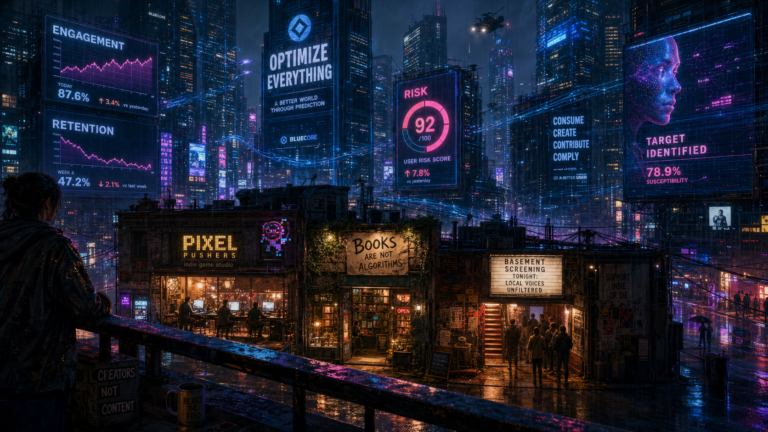
Revenue. Engagement. Retention. Risk mitigation. Market expansion.
That’s it. And that’s okay.
Oh, and thanks to ESG trends, there’s also optimization toward ideology-based scores that have absolutely nothing to do with producing a quality product. In these cases, profits are happily sacrificed for the “greater good” of carrying a certain ideological message. Thanks to financial backers with near infinite money to lose, this will keep happening.
No, ESG is not inherently bad — but it does prove where capitalism at scale breaks down. When compliance becomes a score, larger companies just see a framework they need to check boxes on. Actually caring about the outcome is not a control on the framework. (Trust me, I work in cybersecurity compliance.)
If a corporation can swap originality for something safer, broader, and more predictable, it will. If it can turn a once-great IP into a lowest-common-denominator content pipeline that prints money globally, it will do that too. Not because it’s evil. Because it’s rational.
And yet people act shocked every single time.
At some point, the issue stops being what corporations are doing and starts being what people expect them to do.
Are you expecting meaning from a machine designed for optimization?
That’s not a capitalism problem. That’s an expectations problem.
You’re Only Looking at Half the System
The critique usually stops at the top: massive corporations, consolidated media, risk-averse decision-making.
But that’s only one side of capitalism.
The other side is the part people conveniently ignore: capitalism doesn’t just allow corporations to exist. It allows anyone to create, distribute, and sell.
Indie authors.
Solo game developers.
Small film teams.
Weird, niche creators with no interest in mass appeal.
All operating in the exact same system.
No board of directors. No shareholders. No brand safety committees. No need to appeal to the broadest possible audience on Earth.
Just creators, making things, and putting them directly in front of people.
That’s not a loophole in capitalism.
That is capitalism.
The Real Lever Isn’t Complaining
Here’s the part people don’t want to hear: outrage is not a control mechanism.
You can post all day about how a studio ruined your favorite franchise. You can write threads, record videos, dissect every bad decision. (I have been known to do this.)
None of that actually moves the needle.
Money does.
Time does.
Attention does.
Those are the inputs capitalism responds to. That’s the signal.
If you keep buying the games, subscribing to the platforms, watching the shows, and engaging with the content — even hate-watching — you are feeding the exact thing you want changed.
The system doesn’t care why you showed up.
It only cares that you did.
“Just Don’t Buy It” Isn’t the Whole Answer
There’s a reason people don’t like this argument: it sounds too simple.
And to be fair, it is incomplete.
People are locked into ecosystems. They’ve built libraries on platforms. Their friends are in those spaces. Convenience is powerful. Habits are sticky.
You don’t just walk away from that overnight.
But that doesn’t mean you’re powerless. It means the lever works in two directions:
- You withdraw support from what you don’t want.
- You redirect it toward what you do.
Disengagement matters. But replacement is what makes it stick.
The Parallel Economy Is Already Here
While people argue about what massive studios are doing, an entire parallel creative economy has been quietly scaling in the background.
Indie games that you can actually own.
Self-published books that don’t go through gatekeepers.
Creators building direct relationships with their audiences through crowdfunding and subscriptions.
No one asked permission to build this.
They just did.
And every dollar that flows into that ecosystem makes it stronger. Every hour of attention shifts the balance, even if only a little.
That’s the part of capitalism people overlook: it doesn’t require permission to route around things you don’t like.
The Machine Reflects What You Feed It
If millions of people keep pouring money and attention into safe, recycled, lowest-common-denominator content, that’s what the system will produce.
Not because it’s broken.
Because it works as designed.
And if enough people start redirecting those same resources into smaller, riskier, more interesting work, the system adjusts to that too.
Slower than anyone wants. Messier than anyone likes. But it moves.
That’s the deal.
Stop Yelling at the System. Use It.
Blaming capitalism for bad entertainment is satisfying. It feels like you’ve identified the villain.
But it’s also a dead end.
You’re not going to shame a corporation into caring. You’re not going to tweet a billion-dollar studio into changing its incentives.
If you want different outcomes, you have to engage with the system on the level it actually operates on.
Support what you want more of.
Ignore what you don’t.
Be intentional about where your time, money, and attention go.
That’s it.
Not glamorous. Not instant. But real.
Capitalism isn’t your enemy here.
It’s a machine.
And whether you realize it or not, you’re one of the inputs.