You want to make it as a writer in the 2020s? I’ve got everything you need to stand out and succeed, whether you’re looking to write for Hollywood, land a book agent, or sell your streaming show scripts.
Let’s gooooo!
Colonize someone’s IP.
All that fan fiction is about to pay off, because legacy media knows damn well that audiences don’t care about original properties. They’re going to want you to write the next Spiderman movie or Star Wars show. And if it’s a Spiderman movie, it’s going to be the 100th time you have to explain his origin, because that’s what audiences crave.
Don’t worry. You’ll still be free to let your creativity run wild, because no one cares about those IPs, either. You see, audiences just want to see familiar names and logos. A five-decade legacy of good stories shouldn’t stand in the way of your dreams of making Wookiees into drag queens or whatever. If you’re stuck with Spiderman, you still have to show him being bitten by a spider, but you can make it completely new and unique by making Peter Parker a gender fluid dwarf.
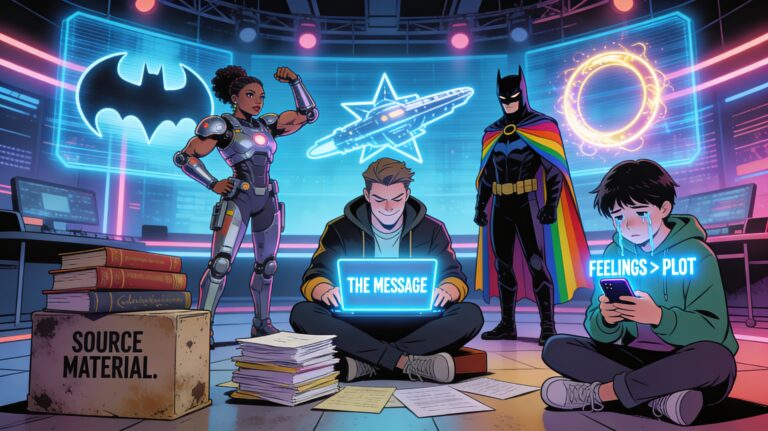
Never EVER read the source material.
When you’re put in charge of adapting a property (some old bestselling novel or whatever) it basically becomes yours. Since you can do whatever you want with it, there’s no point wasting time actually understanding it.
At most, you should skim the first chapter of the novel or watch the first movie/show in the long-running series. Try to remember some of the character names, and maybe some locations (i.e. “I get to write the next Star Trek show, so maybe I should have it in space or whatever. I guess when I gender swap Captain Kirk and make her a rebellious 20-something who runs a cat cafe, it could be on the moon.”)
You only need to know enough about the original work to carry out the next step…
Subvert the source material.
This is a hard and fast rule: nothing shows the world how clever and “punk” you are like making everything the opposite of what it’s supposed to be. Subvert! Subvert everything!
Forget that you can’t tell the truth and subvert reality at the same time. Doesn’t matter. Your job is to make every competent character into a loser, every worthwhile pursuit into a hopeless cause, and every villain into a hero.
Don’t bother asking deeper questions about why any of these changes are being made. You don’t want to overthink your subversion. Just write like it’s “opposite day” and you’ll be fine.
Modernize, modernize, modernize!
Are you writing in someone’s carefully crafted medieval high fantasy world? Feel free to update that old nonsense with modern language and sensibilities that feel right at home in 2020s California (and nowhere else in space or time).
Sure, Tolkien created entire languages for Lord of the Rings, but who has time for that crap? Just write dialogue like you and your friends would talk (online, of course) and everything will be fine.
And forget making the story about a battle between good and evil — who could relate to that? Write about how hard it is to be a certain identity group. (Bonus points for making an entire series about an intersectional identity group with a population of exactly ONE person. Talk about relatable!)
Make sure your story is for everyone.
The key to making your story for everyone is to make it about yourself. Since everyone likes you, that means literally everyone will relate to your story.
There is absolutely no risk to this line of thinking, and it will always work out.
Avoid any semblance of morality or discussions about the same.
Broader morality doesn’t exist — it’s all about what you think is good and what you think is “icky”. Make sure every character in your story thinks exactly the same as you about every possible topic. This, again, will make sure that everyone loves all of your characters! Because you’re so great!
That’s the goal of writing stories, after all. Making everyone like your characters…and by extension, like you.
But what about conflict? I’m sure people have told you that stories need that, right?
Uh oh. Since you’re on the right side of history, you believe that every single person is exactly the same as every other person in every way, so it doesn’t leave much room for conflict…
…or does it?!?
It actually makes conflict stupid simple! Stay with me.
If everyone is exactly equal, then the antagonists are people who don’t believe everyone is equal. There’s literally no one else they could be! No, seriously…think about our Hollywood ideology. There’s no one else who could be cast as “bad” or “wrong” if everyone is equally perfect just the way they are.
Make your female characters exactly like men.
This can be a tricky topic, because we already know that everything about men is bad, but the key to writing modern female characters is just to write them…like they’re men.
Don’t think too hard about this. Just follow along.
Forget women who are competent and complex. And don’t even bother with any that are feminine. (What is this, the 1700s? lol)
Your strong female character should basically be the worst possible frat bro but in a female skin suit.
Make your females sexually liberated to the point that they have zero morals and swipe right on every opportunity. Ensure they try to resolve every conflict through intimidation, and if that fails they have no qualms about resorting to violence. They should be better than everyone else and know it. Most importantly, make them physically strong. Stronger than whatever men happen to be around them. Oh, and push that “independent” thing to the absolute threshold of insanity — if anyone even mentions families around them, they should jump out of their skin suit and kill them.
Just channel “toxic masculinity” into a female body, and you’ve got the perfect modern “empowered” female character. Did we just say that X behaviors are terrible, but the same behaviors on a woman are aspirational and awesome?
NOPE.
Okay, I know. The math makes no sense whatsoever. See:
- If A = Female; B = Male
- A = B (equity)
- A > B (girl power)
- All things are A (equality)
- A > A with a wang (?)
Congratulations, you just unlocked the new wave feminism achievement.
Roll out the stereotype struggles.
Stories are all about conflict, but that’s kind of hard to write. Politics, wars, moral struggles on a grand scale — bleh! Just make the central conflict of your story about how some people are mean to other people.
If you’re worried that you can’t possibly stretch that weak premise into 19 hours of TV episodes or a trilogy of feature films, just look at everyone who has tried (and we assume, succeeded) before you!
A great writing trick is to work backwards from your ending. Since you’re a modern writer, we already know the ending of your story will be some variation of “the protagonist was perfect all along, and they just needed to realize it.”
Working back from that message, you have a lot of options! Well, really only one. You make a bunch of people be mean to the protagonist. Shortcut ahoy! Make them mean because of the protagonist’s identity, not because of any choices they’ve made or actions they’ve taken.
(Ugh. Choices and actions are hard.)
Feelings beat plot.
For thousands of years, writers have concerned themselves with things like story and plot. Recently, we’ve learned that none of it actually matters, so the centuries of perfecting our understanding of narrative were complete wastes of time!
What matters is feelings. Your feelings, the characters’ feelings, the reader’s feelings, your dog’s feelings. Feelings are pretty basic and lack depth, so writing about them is super easy.
Want conflict in your scene? Make someone get angry and yell. Doesn’t matter why they do it.
Want to pull at your reader’s heartstrings? Make a character break down into tears and talk about childhood trauma. Who cares if it’s in the middle of a fight scene or a car chase…feelings are more important than stuff actually happening!
Make everyone stupid.
Writing is much easier if you just assume all of your characters have an IQ in the single digits. This absolves you of all responsibility for their actions being “logical” or “humanlike” in any way.
And remember, stupidity mixes really well with feelings. If you think stories driven by emotions are easy to write…wait until you try driving the story with the emotions of really stupid people!
That’s basically like throwing a molotov through the window of a fireworks store. You can have emotions exploding all over the place for no reason! And no one has to act like a real person EVER.
Never forget how stupid your audience is.
The other reason modern writing demands that you write stupid people is that your audience is probably pretty stupid, too, and they need relatable characters or they won’t put down their phones long enough to watch/read.
You never, ever want to give your reader or viewer the benefit of the doubt. They will not be able to figure out your super deep subtext, so always spell it out. Want to inject some humor? Your audience is too thick to get a joke, so you should always make it a joke they’ve already heard…and then explain it just in case.
Look, we all know there are two reasons modern writers even pick up a pen: self validation and to spread “the message”. Which is really just self-validation, so I guess there’s only one reason.
When your audience is as dumb as yours is, you really need to shortcut your way to these outcomes. Put yourself in the story (Hell, do it literally. Be a character in your own story. The MAIN character. People will love that!)
And as far as getting the message out, that’s easy. First, check with Hollywood elites who have no concept of reality to see what is considered “good” this month. Next, write all of your main characters such that they adhere zealously to those ideals. Then make your antagonist(s) think in some other way, thereby making them “the baddies” in the mind of your audience. Your protagonists beat them, and the status quo is achieved. Well done!
Prepare your defenses.
The great burden of being a modern, millennial writer is that you know damn well you’re going to get “review bombed.” You see, a lot of people are going to hate your work — most people, actually. But that’s not your fault.
It’s their fault.
If you follow this guide to the letter, you can rest assured that you’ve done everything right. You’ve made everything about yourself, you’ve crapped on thousands of years of social evolution, you’ve made feelings more important than reality, and you’ve destroyed beloved IPs by pandering to the smallest possible slices of the viewing/reading audience.
How could you possibly deserve bad reviews?
Reviewers aren’t actually judging your work (because it’s perfect just the way it is and you just needed to realize it), they’re attacking you because they’re bigots, misogynists, etc.
Here’s your best response to ALL incoming reviews: “If you don’t like my adaptation of X, then you’re not a real X fan.”
Sure, it makes absolutely no sense. To anyone. For any reason. I’ll show you:
Let’s say I made lasagna, but instead of putting Ricotta cheese in it, I put badger vomit. Now you eat it and you tell me it tastes terrible. My response is “Well, if you don’t like my vomit lasagna, you’re not a real fan of lasagna.”
There’s nothing logical about that response. It’s basically just trying to gaslight you and is incredibly dismissive of your opinion. In reality, it should make everyone hate me more for even saying it.
Hm.
Moving on!
Bonus Cheats
Is this still too hard? Yeah, writing can be. But the goal of the millennial modern writer is to make it as easy as possible. Here are some tips!
Write about teenagers. Adolescent struggles are simple and emotionally driven. Plus, you can make teenagers convincingly stupid, which satisfies one of our key points. Write what you know!
Tell your story. If you’re an MFA, you’re probably already planning to do this. If you’re not fortunate enough to have been fully trained in the egocentric, self-absorbed ways of the now-now times, let me fill you in: Your story needs to be told. Doesn’t matter if it’s boring, or if it’s been told a million times. No one wants to read about epic fantasy battles or spaceships. They want to read about how someone hurt your feelings that one time. Congratulations! You now have an MFA.
Want to blow people away with your prose? Throw out some meandering tautologies or contradictions. “Life is tragically long and beautifully short” or “Lies are just truths that aren’t true.” These phrases may be pointless drivel, but when people aren’t paying attention, they sound really deep.
Ride trauma until the wheels fall off. Good characters have flaws, modern characters have trauma. Why? Because our characters have to be perfect just the way they are (they just need to realize it) they can’t have flaws. But you still need them to overcome something, so you have to give them some kind of past trauma. That’s like giving them a flaw, except it’s not their fault because someone else did it to them. Remember, making everyone into a victim is a powerful modern writing tool!
Conclusion
Look, I understand if you want to keep doing things the hard way. You want to tell actual stories that examine moral conundrums and engage the audience’s brains. That’s cool, bro.
But if you want that crap you’re going to have to go independent. No publisher or producer will touch you. You will probably be cancelled by the virtue signaling crowd…and they’re really loud and have a lot of time on their hands.
Or you can give in and follow this guide to glory. Up to you!